I read one of Assaf's recent blogs about privilege. It is hard to make a large societal change, but it is possible to make a small change for the people who you interact with regularly. I've recently been thinking about some of the experiences I have had in academia as a woman. Some of it has been extremely negative. I've dealt with a lot of sexism, and quite a bit of harassment. However, I can also think of times where people have done small acts of support/kindness which made going through this process much easier. I want to focus on these positive experiences. In particular, I want to talk a bit about ways in which people made me feel supported, and some examples of support I try to give others which have worked. My goal here is to try and encourage those reading to think about small changes they can make to support those around them.
Something new I tried this year was including an inclusivity statement in the syllabus for the class I taught. Of course, most people didn't read this inclusiveness statement, but some students approached me and told me that they felt particularly comfortable approaching me because of this statement. Additionally, this statement made some of my students comfortable enough to approach me about some of the issues they were having, often related to being a part of some minority group, and we were able to talk about how I could make the course better for them.
I've always struggled with having students take me seriously when I teach, whether it's running a tutorial or lecturing a class. One year, I had another TA send his students to my section because they felt I would be able to teach the material well to his students. This small act actually changed the behaviour of some of the students in my tutorial. It seemed that having one of the other male TAs indicate that I was a capable teacher convinced my students that I could teach them the course. It was at this moment that some of the sexist comments I was receiving weekly stopped, and some of the students who made these comments began asking me honest questions. Something else I think is important is to show support to those whom you know are capable mathematicians. Often, those in minority groups have far less attendance when they give talks at conferences/seminars, and their contributions to their field are often overlooked. Recently, I've noticed that there is a group of men in my field who purposely go to talks of those who are minorities to show support, even if they have already seen the talk before. If they can't make the talk for whatever reason, they will speak highly of the speaker and encourage others to attend that talk. Having people show up really helps people feel validated and like their work is important. I've also had this same group of men offer to read my paper with their reading groups. Not only does this make me feel as if I've actually made a contribution to mathematics, but I now have others reaching out to me about my work, and people are beginning to recognize my name. These acts have really increased my confidence, and has made it significantly easier for me to feel comfortable talking to other members in my field.Speaking to members of minority groups, I know that many of them are concerned about facing harassment whether at their home departments, or at events which they attend. If you're too nervous to step into an uncomfortable situation like harassment, it is still possible to alleviate some of the negative effects of this harassment. When you see the person who you noticed was dealing with harassment, approach them and ask if they would like to join you/your peers at a meal or if they would like to sit with you for the next event. Always ask them how they are doing, and really listen to the answer they give you. It might just be a polite answer, but maybe they need someone to talk to. Also, ask them some questions about themselves and about their work. Everyone likes to talk about the material they are working on, and maybe you'll have some common research interests. And of course, if you are comfortable stepping in, please do so. If someone is sticking up for themselves to a harasser, sometimes all you need to do is stand next to them in solidarity. Other times, I find asking them if they would like to leave the situation works wonders since they are given an easy way to leave, and the situation isn't going to get worse.
I think it's important to mention that you always have the power to choose whom you support. If you know that someone is consistently harassing others or displaying behaviours which are sexist/racist/homophobic etc., you can choose whether to support this person. Support takes many forms: showing up to their talks, citing their papers, and inviting them to go to social events are a few ways you show support for someone. By doing this, you may be actively excluding those from minority groups since they may be uncomfortable participating. This isn't to say that people aren't allowed to make mistakes, and that people can't change, but it is important to show that you find this behaviour unacceptable and that it does not belong in academia/the workplace.
Lastly, know that you're going to make mistakes. It is important to forgive yourself in these situations, and to just try and do a bit better tomorrow. If you make a mistake, be open to having a conversation if this mistake hurt someone, but also be open to walking away from the situation if this is what makes the other person the most comfortable.
As much as I want the world to change and be inclusive to everyone, we are a long while away from this. That being said, it is definitely possible to try and make things a bit better for those around you, and its not bad to have a goal to treat those around you a bit better everyday.
I've been biking for so long along roads, that I've started thinking of myself as a car. Like a cat amongst dogs, as my dad says. I look at cars on the road, and see my right to be there. I've been on the road for more kilometers than any of these chums.
By now, I am more road than anything. There's a thin layer of greasy road on everything I own. From my bags, to my bike, to myself. My water bottle's got it, my food probably has it, and I've been taking extra care to make sure that my toothbrush doesn't have it. I've reached the point where I use the pavement as a plate. If anyone's got the right to use the road, it's me.
The Utah highway patrol disagrees. This morning, I planned on a straight, flat route along wide shoulders with no dangerous city intsersections, no unexpected turns, and well marked roads. Today I planned to take the interstate right down to downtown Salt Lake City. I got on, and started going fast. The road conditions were perfect, and I was just flying along at an incredible speed. I managed to do about 20km before the fuzz, seeing that I was having too much fun, stepped in.
I told the patrolman that in Utah, I am allowed to ride on the interstates. He told me that I can't, because it's a controlled exit freeway (this is not the reason I wasn't allowed here, by the way). I asked him what I was supposed to do after I left Salt Lake City, as the only reasonable route does go through some freeways. He told me to take frontage roads, backcountry access roads. Yeah, those barely-paved pieces of trash that are mostly used to haul farm equipment.
Let's talk about safety for a minute. A priori, it would seem that the freeway is more dangerous than an access road. You'd think, just like the patrolman did, that the occasional farmer driving at 30km/h is less dangerous than thousands of cars zooming by at 120km/h. However, this is not the case. From experience, I know that no matter where you go, cars will go fast. I've had steep uphill climbs with winding roads along cliffs with no shoulder, and cars speeding by at crazy speeds with barely a foot of clearance. Freeways have shoulders. Always. Freeways are straight - cars can see me from far away.
None of this even touches on the fact that in case of emergency, the freeway is busier, or that intersections are where most accidents happen, meaning that the freeway is safer for these statistical reasons too. All this is just l'esprit de l'escalier, and carries no legal standing. At the time, I just said that it's legal to ride on the freeway as long as no other reasonable alternative exists.
Apparently, there are suitable alternatives in Salt Lake City, and as I learned later, it's only illegal to ride on the I-15 freeway between Nephi and Bringham City. If you've never heard of these places, then just imagine a 100km no-go zone around Salt Lake City.
And so, with the patrol car escorting me to the nearest exit, I enjoyed the last bits of the good highway before having to muddy my mood with the twists and turns of suburban riding.
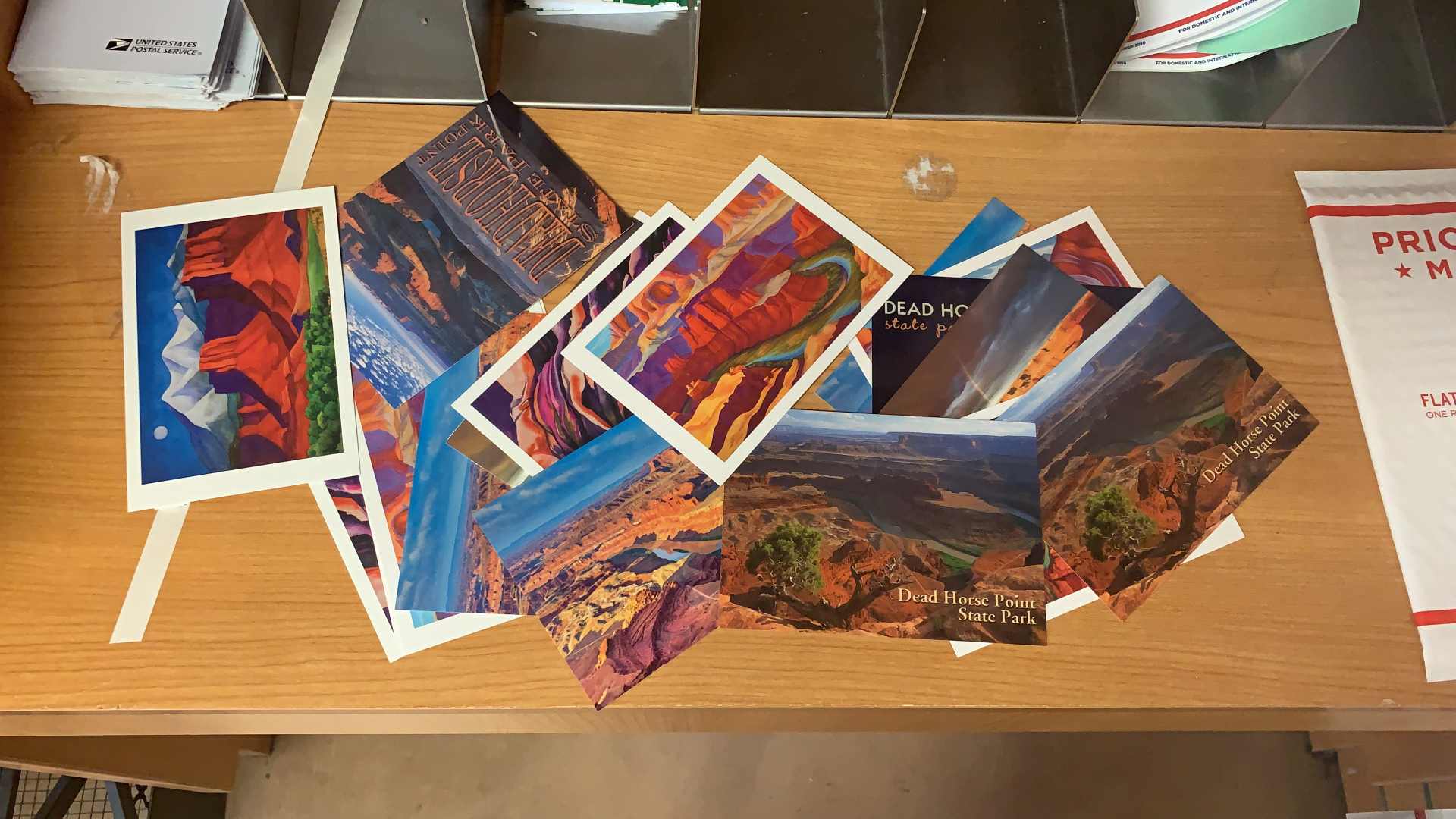
The only fun thing I did today was stop at Chipotle for lunch and fill in lots and lots of postcards:
I eventually made it to Salt Lake City, where I took a quasi-highway main road kind of deal that was long, straight, and had no bike lanes, or shoulders, to my host, Kenna, whom I met through warmshowers.
My aunt, Rutie, made an interesting case that everything here is based on Israeli geography. Great Salt Lake is the dead sea, Lake Utah is the Kineret, the desert is the desert, and the red hills look a lot like Petra, Jordan. The mountains around me are the Golan heights, and the river from Lake Utah to Great Salt Lake is, you guessed it, called the Jordan River.
Today I biked for 90km over the course of five hours.